Is he a bird? What happens when your two memory systems disagree
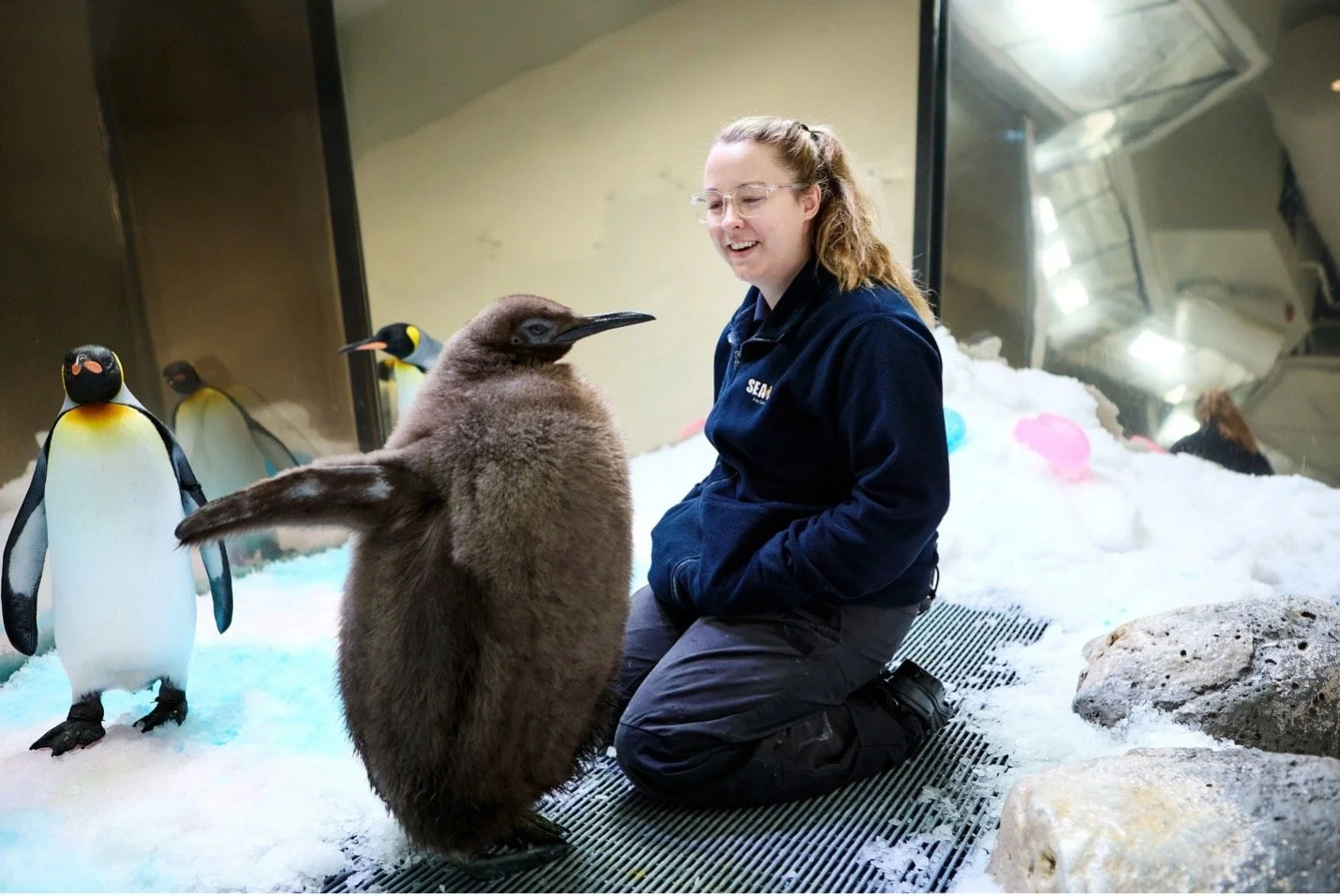
Pesto the penguin with one of his keepers. From CNN.
Let me ask you something – is Pesto a bird? That might seem like a silly question, but to answer it, your brain needs to reconcile two things. First is your brain’s intuitive concept of a bird. It’s not easy to describe with words, but when you think of a bird, you probably think of something small, agile, and flying, like a robin or a sparrow. In other words, you probably don’t think of a large, flightless penguin like Pesto. However, factually, you know that he has feathers, an essential characteristic of a bird. So, your intuitive knowledge of birds clashes with your factual knowledge – What happens in your brain when these two kinds of knowledge disagree?
Memory scientists believe that our brains have two learning systems. One system learns through repeated experience, gradually picking up patterns without always being able to describe them with words – This system helps us learn our intuitive knowledge. The other system learns explicit rules and facts that we can easily put into words. When I asked you about Pesto earlier, both of your learning systems probably had different answers: Pesto does not align with your intuitive sense of a bird, but he does align with your factual knowledge that penguins are birds. So, when you answer that question, does one memory system work alone, or do both memory systems work together?
In their latest study published in Psychological Research, Drs. Priya Kalra, Laura Batterink, and John Paul Minda conducted an experiment to figure out if your brain tries to use both kinds of information at the same time – in other words, if both systems work together. In this study, people learned to sort aliens according to which of two rocket ships they would use. They learned a rule that would help them sort the aliens by looking at their eyes and mouths, and they got lots of practice to help them remember this rule.
This might sound pretty easy, but there’s a secret the learners didn’t know: The aliens in each rocket ship tended to be different colours! Colour wasn’t part of the rule they were taught for sorting the aliens, but there was a pattern: one rocket ship had warm-coloured aliens while the other had cool-coloured aliens. While learners studied the aliens’ mouths and eyes, their brains were also quietly learning about the colours, building up their intuitive knowledge.
Later, the researchers tested learners on which aliens went into which rocket ship. Sometimes, the mouth-eye rule and colours would guide people to the same rocket ship. Other times, the rule and the colours would lead to different ships, creating a conflict that their brains would need to resolve if both kinds of knowledge were being used at the same time during the test.
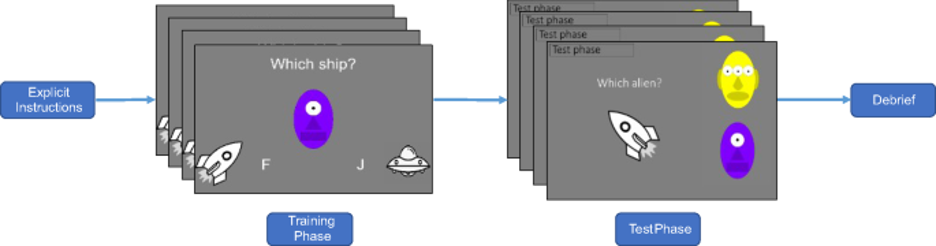
(Training Phase) After being taught the rule for sorting the aliens based on their eyes and mouths, learners practiced sorting the aliens. (Test Phase) After getting lots of practice, learners were tested on their ability to associate the aliens with their rocket ships. From Kalra et al. (2025).
They found that when the rules and colours conflicted, learners took an average of 143 milliseconds longer to respond! This is a small delay, but it means a lot in our brains. This delay is evidence that your brain is working to resolve the conflict. Even though the colour of the aliens was never taught to people, we can see that it influenced them during the test. So, both memory systems are probably working together!
So, when I asked you about Pesto earlier, you might’ve paused for a split second before saying “Yes, he’s a bird.” That tiny pause is a sign that your absolute unit of a brain is working hard to overcome the conflict between your learning systems.
Original Article: Kalra, P. B., Batterink, L. J., & Minda, J. P. (2025). Procedural and declarative knowledge simultaneously contribute to category response selection. Psychological Research, 89(5), 146. https://doi.org/10.1007/s00426-025-02162-9