When Math Meets Dr. Seuss: Our Brain’s Shared System for Mathematics and Language
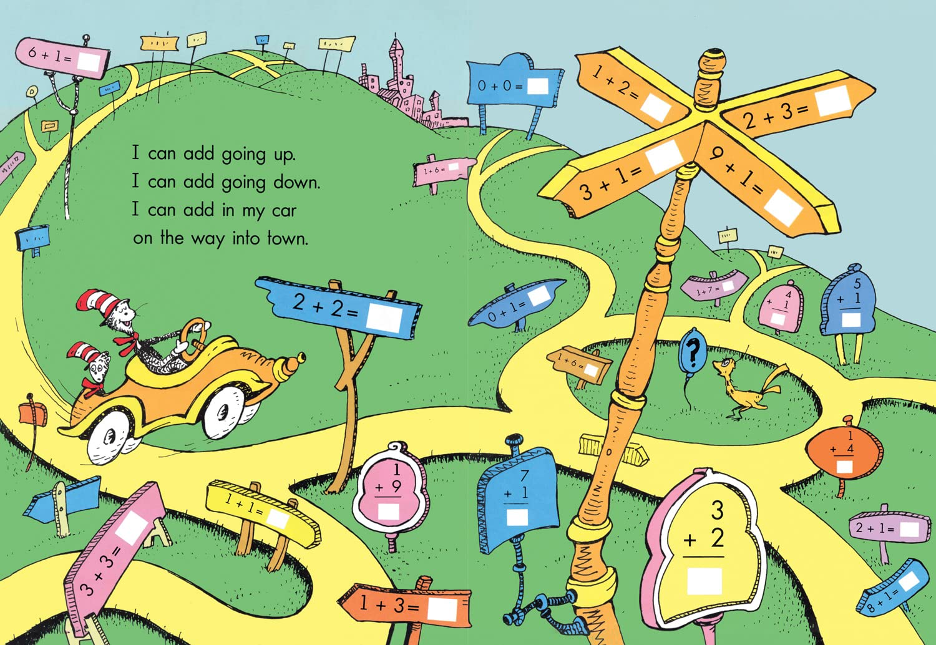
I Can Add Upside Down by Dr. Seuss
Picture this: you are in primary school, and you are sitting cross-legged on the carpet shoulder-to-shoulder with your classmates listening to your teacher read aloud I Can Add Upside Down by Dr. Seuss. The cadence of the story brought so much joy; you could almost predict the rhyming endings! After the read-aloud, you joined your classmates in small groups to practice arithmetic, like 4 + 2 and 3 + 5. At first, you needed to count with your fingers, then you started using counters, and now, you have these arithmetic facts memorized.
In primary school, math and language class were often kept separate, but new findings suggest that there may be a greater link between these two subjects than previously thought. The rate of co-occurrence for a diagnosis of reading and math disability is between 11 to 70% according to some estimates. This co-occurrence rate far exceeds the rate expected for independent conditions.
The networks of brain regions involved in reading and in arithmetic have both been well-studied individually, but do these two networks overlap? Does this change with age? And how? These were the primary questions that Dr. Aymee Alvarez-Rivero and her colleagues wanted to answer in a new study published from Western University’s Numerical Cognition Laboratory.
Dr. Aymee wanted to examine the neural overlap between simple arithmetic, such as the earlier math facts described (i.e., 4 + 2), and phonological awareness, which is the ability to manipulate the sounds in words, such as being able to list words that rhyme with cat, like hat. Remembering math facts requires the ability to map sounds to Arabic numerals, and importantly, verbal memory, or memory of words, such as recounting “three plus five is eight”. Dr. Aymee hypothesized that since simple arithmetic problems require verbal memory retrieval, the brain network for these simple math facts will engage a similar brain network as that for phonological processing. Furthermore, she hypothesized that larger arithmetic problems whose answer exceeds ten and requires explicit mental manipulation, like “8 + 7 = 15”, will engage a different brain network than that for phonological processing.
To test her hypotheses, Dr. Aymee and her co-authors recruited 41 children in 4th to 9th grade and 34 adults from the London, Ontario community. They used two different brain mapping methods, the first being a conjunction analysis, where they used brain imaging (fMRI) to identify the overlap in brain activity during rhyming and arithmetic. The authors found that arithmetic and rhyming may share activation in not only one but multiple regions along the reading network.
Four overlapping brain regions were identified. During both rhyming and arithmetic, Dr. Aymee found that the inferior frontal gyrus, or the IFG, was activated. This was true for children and adults. The IFG has been shown to be involved in both math and reading skills, particularly in rhyming and articulation. Other overlapping brain regions include the inferior temporal gyrus (or ITG) and cerebellum in adults, and parts of the frontal cortex in children. These regions differed between children and adults, suggesting that the brain systems supporting math and reading may change with development. Firstly, the ITG is thought to facilitate rapid recognition of symbols, i.e., letters and numerals, which may support fluent reading and arithmetic in adults. The cerebellum is thought to be involved in coordinating multiple processes, including reading and math. Finally, children may have overlapping brain activity for math and reading skills in the frontal cortex because of this region’s involvement in cognitive control and working memory, indicative of more effortful processing.
Using the same fMRI data but analyzed differently, the authors studied the patterns of activity corresponding to different arithmetic strategies, one for small problems and one for large, and how similar they may be to rhyming (or phonology). They originally anticipated that math facts (small problems) would show similarity to rhyming since they are typically well-rehearsed verbal strategies. Firstly, they found that both small math problems and large math problems showed overlapping brain activity with the rhyming task, which suggests that both math tasks, regardless of size, likely used phonology. However, they found that large math problems showed greater similarity to rhyming. This was contrary to their expectations!
One potential reason is that larger math problems require verbal memory retrieval and, therefore, phonology. It turns out that there are multiple strategies that participants could have used to solve the problem “8 + 7”. For one, they could have directly retrieved this fact from memory. Another method that participants could have used would be to decompose “8 + 7 = 8 + 2 + 5” and then retrieve “eight plus two is ten” and “ten plus five is fifteen”. Alternatively, participants could also have used approximately known facts, such as “eight plus eight is sixteen” and “16 - 1 = 15”. The next step would be to conduct further research on these different strategies.
Overall, Dr. Aymee and her co-authors used two different brain mapping methods and found that several brain regions within the reading network appear to be involved in both word rhyming and arithmetic in both children and adults. In other words, arithmetic and reading skills share foundational neural mechanisms, so struggles in one area can be linked to the other. This research also points to the possibility that interventions supporting one area can help the other.
Next time you are doing math, consider that your brain solves math problems much like it reads words.
Original Article: Alvarez‐Rivero, A., Peters, L., Joanisse, M. F., Gaab, N., & Ansari, D. (2026). Crossroads in the Learning Brain: The Neural Overlap Between Arithmetic and Phonological Processing. Human Brain Mapping, 47(1), e70446. https://doi.org/10.1002/hbm.70446