
Looking Beneath the Surface: How the Brain Detects and Delights in Humour

Source: Medium
Among the many remarkable abilities that humans possess, one of the most distinctive is our capacity for humour. It strengthens social bonds, eases tension, and helps us cope with stress. Many of us actively seek it out for comfort or a quick mood boost, whether by rewatching our favourite sitcoms or scrolling through funny videos online.
Yet understanding and enjoying humour involves surprisingly complex cognitive processes. Take the infamous line from The Office, when Michael Scott says, “I’m not superstitious, but I’m a little stitious.” To get the joke, we must first make sense of it: he confidently assumes that “superstitious” can be divided into “super” (modifier) and “stitious” (adjective), leading to the wordplay that follows.
This is only the first of a two-step process. After comprehension of the joke, we then experience appreciation (the feeling of amusement that follows). Importantly, these two stages are related but distinct: understanding a joke does not always guarantee that we will find it funny. And yet, even when we already understand a joke, we can still genuinely laugh at it when we hear it again. This explains why we can rewatch shows like The Office over and over without getting tired of them.
Scientists have traditionally attributed these two abilities to the cortex, the brain’s outer layer responsible for complex tasks like problem-solving and planning. Less often discussed are subcortical structures, brain areas below the surface that are often reduced to supportive roles or regulating more basic functions like breathing and heart rate.
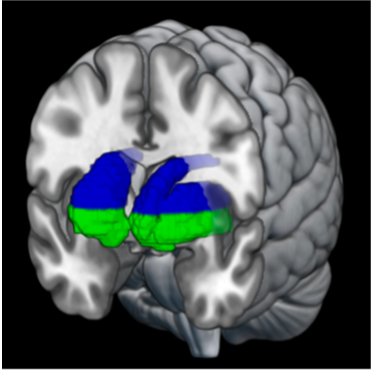
Figure 1. Dorsal (blue) and ventral (green) striatum.
One particular structure that is often overlooked in humour processing is the striatum, which can be divided into two parts as shown in Figure 1. The dorsal striatum (top portion) has been shown to support cognitive functions such as working memory, flexible thinking, and resolving ambiguity – all of which are essential for understanding jokes. In contrast, the ventral striatum (bottom portion) has been implicated in reward processing, an essential aspect of experiencing enjoyment. Together, these properties suggest that different parts of the striatum may contribute to both the comprehension and appreciation of humour.
A team of researchers at Western University, led by Drs. Margaret Poulter (prev. Prenger), Penny MacDonald, and Adrian Owen, tested this idea using functional Magnetic Resonance Imaging (fMRI). fMRI is a neuroimaging method that tracks changes in blood flow throughout the brain over time. When a brain region becomes more active, it needs more oxygen to function. Since oxygen is carried by our blood cells, more active areas will show a temporary increase in blood flow.
While in the scanner, participants completed two different humour processing tasks. One task involved listening to a male voice read a series of sentences, half of which contained humorous punchlines, while the others were simply neutral. The second task involved watching an episode of Seinfeld, a more naturalistic measure that mimics common social interactions and everyday experiences, like flying in an airplane or going to the movies. Both tasks produced similar patterns of results, suggesting they capture the same core aspects of how we process humour.
Using whole-brain analyses (an exploratory method that identifies significant areas of activation across the entire brain), the team confirmed prior findings that cortical areas were involved in both humour comprehension and appreciation, while also revealing activation in the striatum more broadly. To directly test their predictions about the dorsal and ventral striatum separately, the researchers then conducted a region of interest (ROI) analysis, which focuses on specific, predefined areas rather than scanning the whole brain for effects. ROI analyses are particularly useful for smaller structures, where effects may be more subtle and require closer, targeted examination.
The results partially supported their hypotheses: humour comprehension engaged the dorsal striatum, while humour appreciation involved the ventral striatum. Interestingly, though, comprehension also activated the ventral striatum. The authors suggest this could reflect an anticipated reward or a feeling of relief for resolving the joke, an additional aspect of humour processing that could motivate us to make sense of the joke in the first place. Still, these findings support the idea that comprehension and appreciation are, to some extent, separate processes, both neurally and behaviourally.
Despite the distinctions observed in this study, the involvement of the ventral striatum in both processes is particularly interesting. In fact, it is part of a circuit that regulates dopamine, a chemical in the brain associated with motivation, pleasure, and reward. Studies involving patients with Parkinson’s Disease (a neurodegenerative disease) and Major Depressive Disorder (a mood disorder), both of which are characterized by a depletion of dopamine, show disruptions to both humour comprehension and appreciation compared to healthy adults.
This suggests that disruptions to dopamine may affect more than just our movement or mood, but also our ability to engage with humour. In conditions like depression, where reduced pleasure is already a core symptom, this could contribute to a negative cycle in which diminished enjoyment worsens mood even further. By understanding which regions of the brain are involved in these processes, future research can explore whether treatments that target these systems might help to restore a sense of humour. After all, it is an everyday source of joy that everyone should get to experience.
For those of us without these conditions, we often take humour for granted, but the brain does not. Every time you laugh at a joke or smile at a funny video, your brain engages a complex network of circuits and chemical signals working together in harmony.
Original Article: Prenger, M., Gilchrist, M., Van Hedger, K., Seergobin, K.N., Owen, A.M., & MacDonald, P.A. (2023). Establishing the Roles of the Dorsal and Ventral Striatum in Humor Comprehension and Appreciation with fMRI. The Journal of Neuroscience, 43(49), 8536-8546. https://doi.org/10.1523/JNEUROSCI.1361-23.2023