The Building Blocks: Neurons
Neurons, sometimes called nerve cells, are the fundamental building blocks of the nervous system. They act like tiny biological wires, forming complex networks that rapidly pass signals to make thinking, feeling, and moving possible. Neurons are found not only in the brain but also throughout the rest of the body, where they connect to muscles and organs. Through these connections, the brain can control movement, organ function, hormone release, and much more, often without any conscious effort.
Anatomy of a Neuron
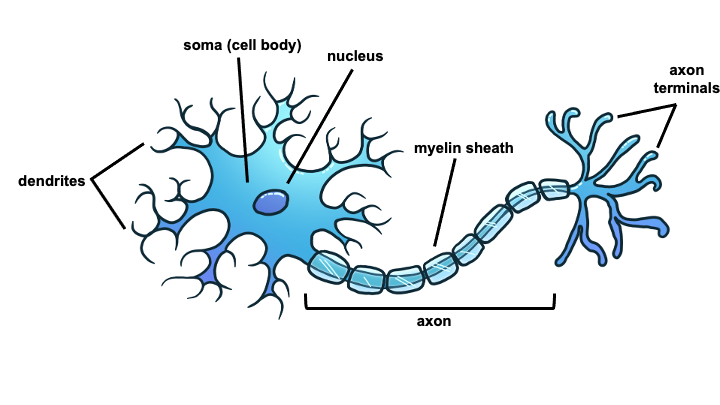
Although there are many different types of neurons, most share three main parts: the soma, axon, and dendrites.
● The soma, also called the cell body, contains the nucleus, which regulates the neuron’s activities, along with most of the cell’s internal machinery (organelles) that keeps it alive and functioning.
● The axon is a long, cable-like extension that carries electrical signals away from the cell body to other neurons, muscles, or glands. At the end of the axon are axon terminals, tiny endings that release chemical messengers called neurotransmitters across the small gap between neurons known as the synapse. Many axons are wrapped in a myelin sheath, a fatty insulating layer that helps electrical signals travel faster and more efficiently.
● Dendrites are tree-like branches that extend from the soma. They receive incoming signals from other neurons and bring them toward the cell body, allowing the neuron to integrate information from many different inputs.
Types of Neurons by Function
One common way to classify neurons is by what they do in the nervous system. A classic functional grouping includes sensory neurons, motor neurons, and interneurons.
● Sensory neurons carry information from the body’s sensory receptors, such as those detecting touch, sound, heat, or light, up the spinal cord and into the brain.
● Motor neurons carry signals from the brain, down the spinal cord, and into the muscles, allowing them to contract and create movement.
● Interneurons connect neurons to one another within the central nervous system (the brain and spinal cord). They are the most abundant type of neuron and play a key role in processing and integrating information.
In the brain, there are many additional neuron types, often with subtle differences in shape, chemistry, and connectivity, which makes neuron classification an active and ongoing area of research.
Types of Neurons by Shape
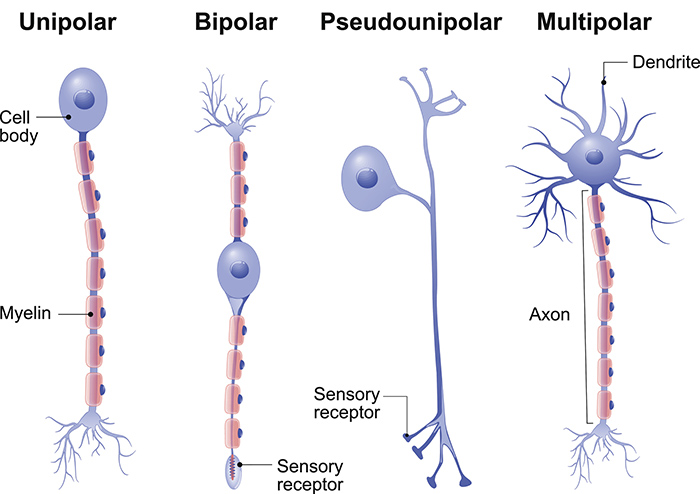
Neurons can also be classified by their physical structure and how their processes (axons and dendrites) extend from the cell body. A neuron’s shape is linked to its function, as it determines how it receives and transmits information.
- Unipolar/pseudounipolar neurons have a single process that splits into two branches. Many sensory neurons in the spinal cord fall into this category.
- Bipolar neurons have one axon and one dendrite. They are found in certain sensory systems, such as specific cells in the retina of the eye.
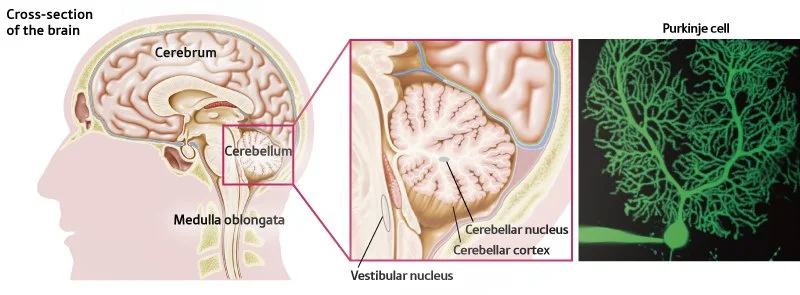
- Multipolar neurons have one axon and many dendrites. This is the most common type of neuron in the human nervous system and is widely found in the brain and spinal cord. For example, Purkinje cells in the cerebellum, the structure at the back of the brain that plays an important role in controlling movement, are multipolar.
Neuron Communication
Neurons communicate by passing signals from one cell to the next. When a neuron is activated, it sends an electrical signal down its axon. When the signal reaches the axon terminals, it triggers the release of chemical signals (neurotransmitters) into the synapse. These chemicals then bind to receptors on the next neuron, passing the message along. This rapid, step-by-step communication allows information to move through neural networks and underlies everything from reflexes to complex thoughts and feelings.
Conclusion
Neurons are the basic units that make the nervous system work. Their specialized structures allow them to send, receive, and integrate information with remarkable speed and precision. By forming complex networks throughout the brain and body, neurons make it possible for us to sense the world, move through it, and experience thoughts, emotions, and memories.
Sources/additional reading:
● https://qbi.uq.edu.au/brain/brain-anatomy/what-neuron
● https://qbi.uq.edu.au/brain/brain-anatomy/types-neurons
● https://medicalxpress.com/news/2010-11-source-long-term-motor-memory.html (Purkinje cell diagram citation)