Looking Beyond the Food: Understanding Eating Disorders
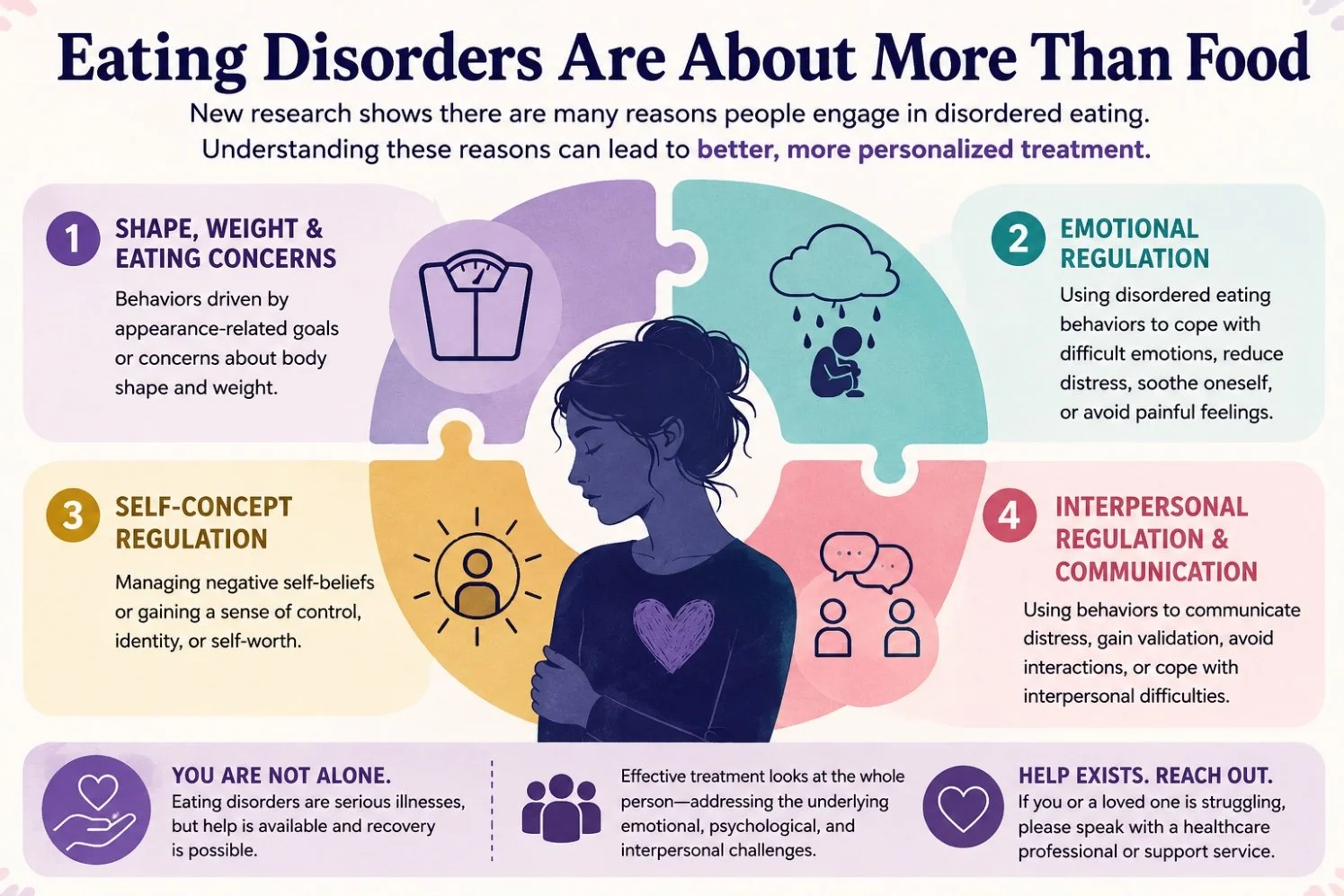
Source - AI Generated
Eating disorders are serious illnesses that can even be life-threatening. In North America, approximately 5% of the population will experience an eating disorder during their lifetime. Despite how common these disorders are, many people do not seek treatment. Even among those who do seek help, treatment is not always effective, potentially because treatments do not adequately target the underlying issues that disordered eating serves. Finding better ways to encourage people to seek treatment, and better ways to treat eating disorders for those who do, is an important issue that needs more attention. To develop more effective treatments, a better understanding of why people engage in disordered eating is essential.
One of the reasons people often do not seek treatment is due to the heavy stigmatization and myths surrounding eating disorders. Challenging common misconceptions may help more people seek treatment and support. Some common myths about eating disorders include:
Myth: Disordered eating is a choice.
Reality: Eating disorders are not something someone simply chooses. What may begin with positive intentions, such as trying to “eat healthier” or exercise more, can gradually develop into a serious disorder.
Myth: Eating disorders are just a phase and will go away on their own.
Reality: Eating disorders are serious mental health conditions that can become life-threatening if left untreated. Seeking professional treatment is far more likely to lead to recovery than ignoring the problem.
Myth: To get better, people just need to eat.
Reality: Eating disorders are often about much more than food. While nutrition is important, these disorders are also connected to emotional, psychological, and social factors.
Getting people to seek treatment is only part of the battle. Once treatment is sought, effective interventions are needed to help those struggling. Understanding the different reasons people engage in disordered eating may help researchers and clinicians develop more effective treatments. To better understand these reasons, in 2023, researchers at Western University explored the underlying functions of disordered eating behaviours.
Disordered eating can take many forms, including restricting food intake, binge eating, self-induced vomiting, laxative use, and excessive exercise. Rather than assuming these behaviours are always driven by concerns about body shape or weight, the researchers wanted to understand the reasons behind them for different individuals.
Not everyone experiences disordered eating in the same way or for the same reasons. To better understand why people engage in disordered eating, Abbigail Kinnear and colleagues interviewed 16 individuals with lived experience of disordered eating and 16 clinicians who treat eating disorders. By including both patients and clinicians, who have worked with a larger group of individuals, the researchers hoped to have a more comprehensive view of the underlying factors behind disordered eating.
In the interviews, participants with disordered eating were asked to describe their eating behaviours and explain why they engaged in them. They were also asked why they believed others might engage in similar behaviours. Clinicians were asked about different types of disordered eating and the reasons they believed people engage in them. From these interviews, researchers identified several common functions of disordered eating behaviours.
The researchers identified four main functions of disordered eating behaviours:
Shape, weight, and eating concerns – behaviours motivated by appearance-related goals or concerns about body shape and weight.
Emotional regulation – using disordered eating behaviours to cope with difficult emotions, reduce distress, soothe oneself, or avoid painful feelings.
Self-concept regulation – for some individuals, disordered eating may help manage negative self-beliefs or provide a sense of control, identity, or self-worth.
Interpersonal regulation and communication – disordered eating behaviours may sometimes be used to communicate distress, gain validation, avoid social interactions, or cope with interpersonal difficulties.
Each function could appear in different ways for different individuals. Further, one person’s eating disorder could serve more than one function. For example, someone who engages in disordered eating could be doing so both to deal with weight concerns and as a form of emotional regulation.
Although the researchers were able to identify four main functions, it is important to note that this may not capture the experiences of all those living with eating disorders. A limitation of the study was that the participant group was not very diverse, as most participants with eating disorders were white adult women (12 out of 16 participants were white, and only one participant was male). As a result, the findings may not fully represent the experiences of more diverse or marginalized groups. Therefore, there may be other functions of disordered eating that were not captured in this study but are important for other populations.
An important outcome from this study was that disordered eating is about much more than simply wanting to change one’s appearance. Effective treatment plans likely need to address not only the eating behaviours themselves, but also the underlying emotional, psychological, and interpersonal challenges contributing to them. For example, Cognitive Behavioural Therapy (CBT) may be able to help individuals identify and change harmful thought patterns related to self-esteem and body image issues, targeting self-concept regulation. Although CBT may help to decrease the use of disordered eating for self-concept regulation, other techniques may be needed to effectively target the other possible functions of the disordered eating. Interpersonal psychotherapy may help address relationship and communication difficulties, while Cognitive Processing Therapy may help individuals process trauma and regulate trauma-related responses. The different functions that disordered eating serves are likely best treated with different approaches; therefore, personalized treatment plans targeting one’s specific underlying factors may be the key to successful treatment.
By improving our understanding of the different functions of eating disorders, researchers and clinicians may be able to develop more effective and personalized treatments. Ultimately, more research will be needed into the development of personalized eating disorder treatments. Hopefully, by providing other ways to serve the functions that the eating disorder had been fulfilling, treatments can prove more effective in the future.
Disclaimer:
If you or someone you know is struggling with an eating disorder, it is important to know that help is available and recovery is possible. Please consider reaching out to a healthcare professional or support service.
Some helpful resources include:
Original Article: Citation: Kinnear, A., Siegel, J. A., Masson, P. C., & Bodell, L. P. (2023). Functions of disordered eating behaviors: a qualitative analysis of the lived experience and clinician perspectives. Journal of eating disorders, 11(1), 141. https://doi.org/10.1186/s40337-023-00854-4